The Beatitudes (Matthew 5:1-12a)
Today's reading is the beginning of Jesus' Sermon on the Mount during which Jesus detailed the Beatitudes.
The Beatitudes can be understood as a framework for Christian living.
Our vocation as Christians is not to be first in this world, but rather to be first in the eyes of God. By referring to the good things that the faithful will experience, we're reminded that those who act in the manner described in the Beatitudes will find their reward with God.
1 Now when he saw the crowds, he went up on a mountainside and sat down. His disciples came to Him,
2 and He began to teach them, saying:
3 Blessed are the poor in spirit, for theirs is the kingdom of heaven.
4 Blessed are those who mourn, for they will be comforted.
5 Blessed are the meek, for they will inherit the earth.
6 Blessed are those who hunger and thirst after righteousness, for they will be filled.
7 Blessed are the merciful, for they shall be shown mercy.
8 Blessed are the pure in heart, for they will see God.
9 Blessed are the peacemakers, for they will be called the sons of God.
10 Blessed are those who are persecuted because of righteousness, for theirs is the kingdom of heaven.
11 Blessed are you when people insult you, persecute you and falsely say all kinds of evil against you because of me.
12 Rejoice and be glad, because great is your reward in heaven, for in the same way they persecuted the prophets who were before you. |
 |
Pulpit to Pews-Cycle A: Fourth Sunday in Ordinary Time
Beatitudes as our Attitudes
In today's world, a person's importance is often measured by wealth, power, and fame. Weakness or powerlessness is generally despised. The liturgical readings invite us to examine our own attitudes of domination and to embrace the Beatitudes as our pattern for living.
Path to Heaven: Jesus outlines the values and attitudes necessary to enter and enjoy God's kingdom. The Beatitudes, part of the Sermon on the Mount, present the essential aspects of Christian behavior required to attain Christian perfection. They express the personal qualities that Jesus' disciples are called to imitate.
There are thirty-seven Beatitudes in the New Testament, of which seventeen are teachings of Jesus. Writing for Jewish Christians, Matthew presents Jesus as the new Moses, teaching from the mountain that Christianity is not merely about obeying the Ten Commandments, but something more profound. In essence, the Beatitudes fulfill and complete the Ten Commandments. While the Commandments, given to Moses on Mount Sinai, are expressed through prohibitions-"Thou shalt not"-Jesus presents the Beatitudes in a positive light. They are virtues to be lived out, leading ultimately to the reward of salvation-not in this world, but in the next.
Go to thaisprings.info to read more about:
✟ Twofold Image
✟ Choose the Way Wisely
The challenge of the Beatitudes is this: Will we seek happiness in the world's way or in Christ's way? Those who choose wisely, who live by the values of the Beatitudes, continuously examine their attitudes, strive to imitate Jesus, and grow deeper in relationship with Him. May the Beatitudes truly become the attitudes of our lives.
Jesus' Blueprint for Holiness - Matthew 5:1-12a
This passage contains the Sermon on the Mount during which Jesus detailed the Beatitudes - the attitudes we need to be truly holy, and therefore happy. In fact, "beatitude" is translated from the Greek word for happiness. Jesus was saying, "Happy are you!" or "Congratulations!" if you live by these attitudes.
When Jesus said, "blessed are the poor in spirit...blessed are they who mourn...the persecuted" He promised that when we turn to God in times of trial, we will be comforted and cared for. When He said, "Blessed are the pure in heart...those who hunger and thirst for righteousness," He was showing us that a holy heart will receive what it desires.
When He described "the meek...the merciful...the peacemakers," He gave us a blueprint for how to act.
We can measure our behavior against these standards. When we are faithful to God in tempting moments, and translate holy inner attitudes into outward actions, we'll know we're on the right path to holiness. When we live by the Beatitudes, we'll be truly happy.
Growing in Faith, Jan. 2023
Sharing in the Blessedness of Christ
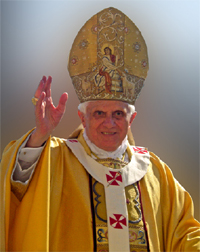 Holiness demands a constant effort, but it is possible for everyone because, rather than a human effort, it is first and foremost a gift of God, thrice holy. The Apostle John remarks: See what love the Father has given us, that we should be called children of God; and so we are. It is God, therefore, who loved us first and make us his adoptive sons in Jesus. Everything in our lives is a gift of his love: how can we be indifferent before such a great mystery? How can we not respond to the heavenly Father’s love by living as grateful children? In Christ, he gave us the gift of his entire self and calls us to a personal and profound relationship with him. Consequently, the more we imitate Jesus and remain united to him the more we enter into the mystery of his divine holiness. We discover that he loves us infinitely, and this prompts us in turn to love our brethren. Loving always entails an act of self-denial, “losing ourselves,” and it is precisely this that makes us happy…. Holiness demands a constant effort, but it is possible for everyone because, rather than a human effort, it is first and foremost a gift of God, thrice holy. The Apostle John remarks: See what love the Father has given us, that we should be called children of God; and so we are. It is God, therefore, who loved us first and make us his adoptive sons in Jesus. Everything in our lives is a gift of his love: how can we be indifferent before such a great mystery? How can we not respond to the heavenly Father’s love by living as grateful children? In Christ, he gave us the gift of his entire self and calls us to a personal and profound relationship with him. Consequently, the more we imitate Jesus and remain united to him the more we enter into the mystery of his divine holiness. We discover that he loves us infinitely, and this prompts us in turn to love our brethren. Loving always entails an act of self-denial, “losing ourselves,” and it is precisely this that makes us happy….
In truth, the blessed par excellence is only Jesus. He is, in fact, the true poor in spirit, the one afflicted, the meek one, the one hungering and thirsting for justice, the merciful, the pure of heart, the peacemaker. He is the one persecuted for the sake of justice. The Beatitudes show us the spiritual features of Jesus and thus express his mystery, the mystery of his death and Resurrection, of his Passion and the joy of his Resurrection. This mystery, which is the mystery of true blessedness, invites us to follow Jesus and thus to walk toward it. To the extent that we accept his proposal and set out to follow him—each one in his own circumstances—we too can participate in his blessedness. With him, the impossible becomes possible and even a camel can pass through the eye of a needle; with his help, only with his help can we become perfect as the heavenly Father is perfect.
Pope Benedict XVI
2005—2013
|